Posted in Emotions, Freedom, psychology

In Dealing with Death

2020 has seen a lot of this. It seemed my friends and I would make it out alive. One of us didn’t.

I am unfamiliar with the grieving process, very new to it in fact, and along with a whirlwind of instant pain, denial, regret, more pain, and consistent waves of feeling the need to give up, pathetic nihilism has punched me directly in the gut.

New followers (welcome and thank you!) may not know, but for those of you who have been following me for the last few months, snooping through my old posts and wondering if I’ve fallen from the earth, know that I approach things from an excruciatingly logical and philosophical standpoint. I use scientific research as support for and against my own curiosities. And so when my best friend of 13 years passed away from child birth complications at 25 from a pregnancy she thought had ended months ago, I fell into panicked logic: everyone dies. She hadn’t been taking care of herself, very rarely cared for her health. The hospital she went to is notorious for poor service. I listed at least a hundred reasons why this happened, but that didn’t soothe all the emotion: fear. Anger. Sadness. Depression. Some more anger. The feeing of unfairness. A hallow feeling for her alive son, 3 years old. Terror: this could have been anyone. This could have been me.

We were going to go “turn up” at our high school reunion together in three years. I won’t be going now.

We were going to hang out on this vacation I’m currently on. We never got the chance.

Our kids were (eventually) going to grow up together. They won’t now.

We talked every day, and although we had many fallouts over really petty things, we knew deep down we cared for each other.

I regret not making more time to see her. Although we constantly told each other “don’t die” when we knew the other was doing some stupid stuff or was sick, I regret that my last text message to her that she never saw, the one I sent before taking off to Ukiah for a few days and a soak at Vichy Springs, was “Don’t die; if you die, I’ll never talk to you again.”

To give that text some context, she had said she was throwing up from some bad pork, and was convinced it wasn’t COVID.

European studies show the grieving process is different for everyone: some benefit more so from mourning in solitude and immediately returning to their daily routine. This could include work, school, family life. The same studies show if those people attend talk therapy or journal, their grieving lasts longer, the dark feelings linger longer and they effectively get worse. The same study showed others needed the talk therapy and the journaling to process the pain. Despite what people think, and despite what I thought, grieving comes in all shapes and sizes.

Living with anxiety and Schizoaffective while on zero mood stabilizers or antipsychotics means big events like this can yank me into Alice’s wonderland. There are things I do to prevent this: isolate, cry, read, and fall into a pit of existentialism.

Why are we here? What is our actual purpose? If we simply die, and we will at any time, any place, for any reason, what is the point of remaining alive? These are questions we’ve all thought about. They’re basic, kind of petty, and when looked at logically not very scary at all. But I understand on an emotional level now why people run toward faith in something, anything–another human, a god, a monster, a devil. Postulating about our own mortality in the first quarter of life, the supposed meaninglessness of it that is, is enough to bring the strongest, smartest, most emotionally stable person to their knees.

I feel that I’ve crossed into another world, this world, but something’s different while everything’s the same. It’s the same feeling I got when I graduated high school and it’s the same feeling I’ll get when I graduate college: that’s over–now what? Why does everything feel new? I wake up feeling like I’ve never woken up before. I eat like I’ve never tasted food before.

I’ve also felt lost about the afterlife. We always told each other we’d haunt one another if one of us died first. She hasn’t haunted me yet.

So, I turned to Daoism for guidance as I always do, before I turned to depression, anxiety, voices, or thoughts of matrix glitches. In Daoism, death is never focused on, and neither is mourning. Death is supposed to be about transformation and the return of The Being to the universe. It’s a celebration, then, that the one who has passed hasn’t really passed, but has just been redistributed. The absence of them, then, is not absent at all. This gives a more concrete understanding to the saying “she’s still with us.” She is, because she is us and we are her and all of us are the universe.

Maybe it sounds cheesy, unbelievable, and scientifically invalid, but we know very well that energy cannot be created or destroyed. In fact, we don’t even really know what energy is other than “a capacity to do work.” I’ve taken so many classes where that’s been drilled into my head that I have no other way of saying it other than that very definition, quoted from every physics, chemistry, and math professor. We also know that matter, down to it’s truest form, is tightly condensed energy. We are energy. We cannot be created or destroyed, in a particle sense, and so in some way we are redistributed: whether that be into soil, into the mouths of maggots, or any other disgusting decomposing terms you can think of. The one thing we haven’t really understood yet is consciousness. What is it and where does it go? It’s chemical of course, we all are, but it’s something else too. I wonder if one day we will identify a similar “spooky action” of consciousness.

Daoism also sees death as life, meaning they are both one. Neither can exist without the other, obviously (we wouldn’t have a concept for either if that were the case). But philosophy is philosophy and our observation of things, our mathematical understanding of things, can only go so far as long as we’re trapped in this physical world. Perhaps there is nothing after this life. And what’s wrong with nothing?

If there is nothing, then there is something. Our nothing will be the something, and something tells me we’ll feel that in the nothingness.

I will always miss her.

Posted in Late Night Thoughts

Mental Health Month: Update #2

If this was a full-time position, I’d be fired by now.

I am struggling cognitively in a way that I haven’t in a few years. Writing is difficult. The post on Substance Use will be tomorrow evening after I get off work, granted my mind does not melt from my ears between right now (10pm) and 7pm tomorrow.

You all have been so patient with me, so kind, and have been thoughtful readers.

A big welcome to the many of you who have followed recently in these last three weeks. We will be on a grand writing adventure together.

Until tomorrow, friends

If you want to share your personal mental health experience (anonymously or otherwise) on my website, contact me on here or via my social media below:

Instagram: @written_in_the_photo

Twitter: @philopsychotic

Posted in Late Night Thoughts

Happiness

I’ve been thinking a lot about what it means to be happy. Here are some of my thoughts.

I’ve done what all good, sheep-like psychologist eventually do: create categories for something that is probably far too complex for such an explanation.

But, hear me out.

I’ve reasoned there’s organic happiness and there’s constructed, or synthesized, happiness. An organic happiness would be someone’s baseline: how you are when you wake up in the morning, how you respond to the corresponding events of the day. This is the happiness we often feel we need to correct.

A synthesized happiness, then, comes in peaks and waves from an outside source. It eventually decreases gradually or exponentially. It may be uncertain, untrustworthy, or fleeting.

These thoughts came into my head not only because of our humanly need to correct all feelings we feel don’t line well with other’s feelings, but because there is such a stark difference between the happiness I feel organically, the one that sprouts naturally in my consciousness, a simple product of biological existence, versus the happiness I feel after I’ve accomplished something I had doubts about, after spending a day with the people I love, or after I take a pain pill for my back.

I think I’ve made this distinction because I notice I’m often disappointed in my organic happiness, in my baseline of existence.

There are tons of speculated biological and evolutionary reasons why certain chemicals peak at certain times in our brains–to keep us focused, to associate good feelings with good friends so that we build connections which were at one point most essential for survival, to simply bring us enjoyment. But now, there are so many things in life that can trigger intense rushes of endorphins, like substances and fame, that what we experience in the day to day just can’t compete. I am happier and friendlier when traveling. I am happier and friendlier when on pain medication. I am happier and friendlier to strangers when I am also among people I care for and love.

And so I find now, when I have a moment to rest and reflect, I remind myself that everything is enough.

I’ve had three of my six past therapists tell me I need to tell myself that I am enough, and I’ve tried that, but I think this stretches deeper. I think that realizing that life is enough, that how I feel is enough–negative or positive–is what paves the way for accepting myself. If I can truly believe that every negative feeling exists as a moment ripe with the potential for growth, and that every positive feeling exists as a moment ripe with the potential for contentment (as opposed to: oh no, I’m happy, let’s see how long this lasts), then I think that may be the key to actually existing.

But believing something doesn’t mean I create a mantra and repeat it to myself until I drop dead. That doesn’t foster belief and studies show that reiterating positive mantras to yourself can actually make you feel worse. I measure how much I believe in something by the rate and construction of my reactions. Let me give an example.

Last night while watching television, I felt the same disappointment I discussed earlier: I felt sad that I couldn’t spend every day feeling the fuzzy, determined, focused happiness that pain medication brings. I felt sad that I felt sad about that. I felt sad that my own level of being just didn’t seem to be enough; I enjoy my personality, I admire my intelligence, I accept my flaws, but the feeling of existing, the feeling of being human, limited, temporary, often enrages me. Being just isn’t enough.

And in this moment of realization, my mind reacted with a simple thought: let’s be okay with this.

Now sometimes I have voices responding to my thoughts, or voice-like thoughts responding to my thoughts, but this was all me, it was a reaction that I haven’t programmed. I haven’t spent the last two years off medication waking up every morning spewing “learn to love yourself” and “you are enough” quotes until I repeat them robotic, on demand. I’ve spent my time entrenching myself in the madness, the chaos, the pain. I spent time locked in my room staring at the wall, if that was what my pain was. I spent time walking off waves of panic, if that was what my pain was. I spent time being unhappy, if that was what my pain was. I resisted the urges for bail outs–a psychiatrist would have bailed me out, numbed me to my anxiety, tainted the voices and the paranoia, evened the mood swings and depression. And I would have learned nothing.

This is not to be said in a way where everyone taking medication should be offended. For me, medication was another avoidance technique that I’d perfected through years of trauma. For others, medication is the stability key that allows them the time and focus to come to the same types of realizations I have. We all reach wellness in different ways.

I’ve noticed in depression, I am no longer overwhelmed with sadness because I allow the sadness to spread. I choke sometimes with the paranoia, fight it, try and reason with myself and that often cycles me further. I am still growing. I choke with the anxiety as well, get lost in the sensations of my body, and the doom my mind screams. I am still growing. But the depression, which has been with me since I was eleven years old, has become a close friend. I am 24 years old. It’s taken 13 years to cultivate this friendship.

And so happiness for me does not mean contentment or joy or the absence of sadness. Happiness for me means experiencing being without judgement.

I figured I’d share some of these thoughts with everyone as we plunge through Mental Health Month as well as the Covid Pandemic.

This week we are covering Schizophrenia, Bipolar, and Dissociative disorders, starting tomorrow. The post will be later in the evening (PST) as I have some self-care and some things that need to get done at work. If you have a blog post on those topics that you’ve written and would like to share, or if you’d like to submit your own story, contact me here or on my social media handles below.

Instagram: @written_in_the_photo

Twitter: @philopsychotic

If you enjoyed this post, please share, like, and follow ThePhilosophicalPsychotic. I appreciate every reader and commentator. You give me more reason to continue reporting poorly executed science.

Posted in Community, Emotions

mindful tips

It’s another day in global crisis, my friends, and this has afforded many of us with much more time on our hands than we’re used to. For some of us with mental health problems, the loss of our routine and the possibility of even more financial hardship means certain destabilization.

While reading the Tao Te Ching today, I came across a beautiful quote I wanted to share with my internet community.

In olden times, the ones who were considered worthy to be called masters were subtle, spiritual, profound, wise. Their thoughts could not be easily understood. Since they were hard to understand, I will try to make them clear. They were cautious like men wading a river in winter. They were reluctant like men who feared their neighbors. They were reserved like guests in the presence of their host. They were elusive like ice at the point of melting. They were like unseasoned wood. They were like a valley between high mountains. They were obscure like troubled waters. . . we can clarify troubled waters by slowly quieting them. We can bring the unconscious to life by slowly moving them. But he who has the secret of the Tao does not desire for more. Being content, he is able to mature without desire to be newly fashioned.”

Tao Te Ching, Lao Tzu

We are in the middle of raging rapids. Waves crash, destroy, but they also whisper. We are bound by this eternal gravitation between the Earth, the moon, and the rate of our spin. We can hold water behind a dam, we can melt ice and let sea levels rise, we can trap it in a pool, we can let it evaporate, but inevitably it falls back to earth. We can manipulate its form, but never erase it.

Let’s think of distress in a similar fashion.

I don’t know how you’ve been during this pandemic. I don’t know how your anxiety is, your depression, your voices, your self-esteem, your confidence, your happiness, your family, your pets. (I’d love to know though, leave comments below if you’d like to share, or meet me on Instagram). I know that I personally have braved waves of panic attacks, nights of voices telling me I’m dying and that I don’t exist, trying to trick me into separating from the panic of today. I’ve faced a sense of hopelessness, financial burden, and fear for my parents, one of which has several serious physical underlying health conditions. There’s been days I switch between so many states of emotion that I didn’t have the strength to walk four feet to the bathroom.

Whether you’ve experienced similar things or you haven’t, I urge you to practice yielding judgement of this moment, this very second, as you read this. Let’s not avoid the anxiety, the stress, or the pain we may be in. Let’s not fill ourselves with meaningless distraction. Lets not cling too desperately to the sparks of happiness or joy as if we’ll never experience them again, or as if we’re uncertain when we will experience them again. Let’s instead acknowledge the importance of all states, unified, and accept this moment for what it is.

In this moment, I feel the pain of my back injury radiating down my right thigh. I feel my head resting against the soggy cushion of this couch. I feel the stress of bills tightening my shoulders, where I hold a lot of my tension. Anxiety is cold in my feet. There is also contentment and acceptance. With all these things, I let them be. I don’t seek ways to eradicate the physical pain. I don’t fluff the couch cushions, I don’t scramble to straighten out finances. I’m not warming my feet. I’m not questioning my contentment or acceptance.

It’s not irresponsible to breathe in the moment and accept horribleness for its unique horribleness, or euphoria for its lack of insight. This is not a time to tear yourself apart. This is a time to remind your mind and body that they are a stronger force together than separate.

This moment is one among trillions. Celebrate that. There will never be another like it.

Be well, friends. Practice good information hygiene, and take advantage of as many resources as you can. Volunteer what you can, donate what you can. You’re only as healthy as your sickest community member.

For conversation, support, updates on research and posts, follow me:

Instagram: @written_in_the_photo

Twitter: @philopsychotic

If you enjoyed this post, please share, like, and follow ThePhilosophicalPsychotic. I appreciate every reader and commentator. You give me more reason to continue this joyous hobby.

Posted in advocacy, Late Night Thoughts

Psychoanalysis, The Locked Ward, and Entropy

Some more thoughts to share, friends. Let’s talk psychoanalysis, the locked ward, and entropy.

No, we will not spend countless paragraphs discrediting psychodynamics and psychoanalysis. The facts are there: Freud’s systematic hypotheses were circular, full of confirmation bias, and untestable. This makes his ideas of Psychoanalysis quite useless, inherently flawed, and simply unscientific. However, modern psychodynamics has come a long way, and if you’ve ever read The Center Cannot Hold, by Elyn Saks (if you haven’t, READ IT!) you know that one of therapists which helped her through her cognitive dysfunction pre-hospitalization was indeed a psychoanalyst. Her therapist often took Elyn’s discombobulated words and reflected them, unbiased, nonjudgmental, back to Elyn. This doesn’t happen often anymore, especially not in hospitals, and we lose this understanding that psychosis is not necessarily meaningless. This idea that it may have meaning is derived from psychoanalysis itself, which is rooted in Psychic Determinism: every thought, action, personality quirk, is there for a reason; nothing is ever accidental.

Anyone who says it’s impossible to communicate with someone in psychosis hasn’t really tried. There was a time I did a regular outreach group at the local psychiatric hospital, in which i’d been as a patient before, and there were often people in my group who were by clinical definition incomprehensible. Sometimes people would wander from the group or I’d end early and someone would want to keep talking. To the average person, and I’m sure many of the workers there, the babble was pointless, but there was one particular man who sought me out every time he saw me. And when he said something like “There isn’t anyway to know the ticking and I don’t know where my home is but I know there’s some fact in that”, I’d say something like “it’s hard when we feel lost and can’t find home” or “there’s a lot we can know in the world, and not know”.

This wasn’t easy. I stumbled a lot over my words, trying to keep up with his thoughts, and maybe nothing I said ever resonated as clearly as these words are registering to you as a reader. I wouldn’t know, I’ve never had someone approach me in this way during my worst moments. But it did something. Sometimes the group was just us, and we’d talk like that, back and forth, for fifty minutes. He’d always shake my hand before I left, and this was one of the people the staff “warned” me about, said he could get unruly, loud, disruptive, and although I can never confirm the way I spoke with him as a clear reason why he never appeared aggressive with me, I can say that our conversations were always even tempered, relaxed, human.

I do not advocate for this as the ONLY form of treatment. Acute episodes are terrifying, traumatic, confusing, they require many things. But staff shouting, tackling people, and being argumentative doesn’t reduce the terror, the trauma, or the confusion. I CAN say that.

So, there are positive things to come out of the idea and possibly the practice of modern psychoanalysis and psychodynamics. Let’s be clear though: Freud was wildly inept as a scientist. All of his hypotheses were derived from case studies and never tested with experiments or even standardized self-report data.

Scrolling along some text in my personality book, some reading for classes during COVID, this author caught my attention when he compared the natural course of entropy in the universe to the entropy of our thoughts. Essentially, entropy focuses on how ordered systems, over long periods of time and inevitably, tend toward disorder. Freud had a similar sense about the mind, says this author, and insisted that we attempt to order our thoughts and lives for the sake of our own creativity and growth. Entropy dooms these efforts.

Freud describes his philosophical understanding of his own hypotheses in terms of libido (NOT just sex drive, but a life energy) and thanatos, (not Thanos as I had read, but a drive toward “death”). Libido described one part of the brain designating energy for a process, and in that time such energy could not be used anywhere else in the brain. We know this not to the be the entire story now. Thanatos was not a wish for death, or a fear of it, but was this very recognizable, a very EASTERN idea that everything contains its opposite.

This is essentially a less developed, disorganized form of YinYang. It’s presented in the textbook as quite a novel idea. But Eastern cultures and indigenous cultures across the globe, have held this collective understanding for centuries. Reading philosophy on the duality of life is what helped me come to terms with my psychosis. Freud didn’t do it first, I promise. If anything, he was super late to the party.

He called his version of YinYang the “doctrine of opposites”. While I refrained from rolling my eyes at this, his “doctrine” maintains that everything requires and implies its opposite. That is, life needs death, sadness needs happiness, and one cannot exist without the other. If you’re curious how this really lines up with YinYang, I’d recommend getting in touch with someone who knows this philosophy well, or reading the basics in this post here.

Why is any of this relevant?

I think what I learned, and am still learning, is that pain is not as simple as we want it to be. There cannot be pain without no pain, and there cannot be no pain without pain. You can’t fix your thoughts with medication, therapy, electric shocks, substance abuse. You can’t be broken without also being together. Unifying the good and the bad, not separating them, not fighting with one over the other, has been the key to many of our successes.

You cannot be ill without also being well. That is the message here. If you identify with mental illness, then you identify, also, with mental wellness; there is harmony in the illness, and disharmony in the wellness. We see this often: there are advantages to being anxious sometimes. For me, I know my anxiety makes me more prepared during stressful events. Because i’m panicking all the time, I don’t panic when others do. I’m often a voice of reason. There are disadvantages to being happy: for me, I get wary of this gentle contentment I’ve come to over the years, because of the imminent threat of not being happy again.

A lot of people view that latter statement as a struggle particularly of clinical depression or bipolar. I don’t see it that way anymore. I recognize that is the duality of things: there is inherent unhappiness in happiness. That’s the nature of things.

Labeling the thoughts as defective is the result of the depression, and part of the struggle. Accepting the truth in pain and the dissatisfaction in wellness is recovery.

What do you think?

Curious about research, news, and a community dedicated to “Eliminating Barriers to the Treatment of Mental Illness”? Check out TreatmentAdvocacyCenter.org for more information, as well as support for COVID-19. This post isn’t sponsored by them, I just stumbled across their site and found it highly useful.

For updates on posts, research, and conversations, follow me:

Instagram: @written_in_the_photo

Twitter: @philopsychotic

If you enjoyed this post, please share, like, and follow ThePhilosophicalPsychotic. I appreciate every reader and commentator. You give me more reason to continue this joyous hobby.

Posted in advocacy, Emotions, Peer Support, psychology

Update Post

Tomorrow we will discuss what happens when we get so stuck in our mental health experiences that they become our lives. Sometimes this even leads to forgetting we have a life, or forgetting we have true potential to live the life we’ve always wanted.

Today I have prior engagements to attend to. I have no time to really focus on this post like I want to. Tomorrow will be free.

If you’d like to keep up with me outside of this blog and see how possible it is to live a productive and generally satisfying life with a schizoaffective label, pop on over to my primary social media:

Instagram: @written_in_the_photo

Twitter @Philopsychotic

I talk about struggles, epiphanies, and good days, bad days, and ask questions on Instagram and Twitter. I’d be happy if you joined the journey!

Until tomorrow, dear readers.

Posted in Peer Support, Supporting Friends/Family

Who Advocates For Us?

Because the internet is my happy place (not really, but I’m online a lot), I see a lot of what becomes popular as soon as it becomes popular. I don’t follow trends or imitate them, but I do observe and one thing I observe from the Pop-Mental-Health culture, as I call it, is the individuals who become Insta-famous or YouTube famous for expressing views about mental health.

I click on these advocates with a new hope. And every time I’m disappointed.

The thing about being a pop-advocate is that everything you say is really heard. And when you’re really heard and you say something controversial, you may lose your following and For some of these advocates, an online presence is their lively-hood.

I don’t think anyone advocates for the money–what money? You don’t get money for being positive about mental health. You may if you’re on YouTube with a couple million followers, but how many mental health advocates are there with that status? I do think this gives people purpose though, and combined with the drive to offer support and the hope of wellness to others, it becomes their livelihood.

What makes this an issue though, is if you’re a YouTuber with an okay following, your channel can blow up if you talk for ten minutes about how transparent you want to be with your audience and spill your mental health secrets.

It reminds me of Dave Chappelle’s recent acceptance speech when he won the Mark Twain award. Toward the end, he said something like “And one more thing–I’d like to say that I’m gay. Can’t wait to see what that does for my career here now.”

We almost fetishize this idea of being different. It’s become “a thing” now. The day we truly accept everyone is the day someone doesn’t need to come out and say they’re gay or bi or trans or anything on the spectrum. The day we truly accept everyone is the day we don’t have to feel the need to “film our panic attacks” or us talking to our hallucinations.

In the meantime, our greatest advocates have become a lot of professionals. Which is great–we need professionals. But they’re starting blogs and YouTube channels and talking about what’s good for us. As if they know.

I rarely see a primary source on their social media or their channels or their blogs. A primary source would be a mental health consumer.

I’m not against anyone advocating. In fact, I welcome everyone to stand up and say something about mental health. But to purport that you know what we need just because you have a family member who has struggled, or just because you spent 3,000 hours getting your license (for California), doesn’t make sense. You have no idea what we need.

You can ask us what we need. You can advocate for us by spreading the word that we are individuals who deserve respect and compassion and for the majority of the time are not as helpless as we’re made out to be. You can advocate for research. You can advocate for better understandings of psychosis. You can advocate for women whose anxiety is never taken seriously. You can advocate for men whose depression is never talked about. You can share your own experience. But don’t generalize any of that into “this is how to help someone.” Because you have no idea what’s helped.

Maybe medication has calmed your son down. Great! So you advocate for medication without understanding what that means. Maybe your daughter getting off medication has saved her life. Great! So you spread the word that medication is poison without understanding what that means.

So, let’s talk about what advocacy has turned into lately. I’ll list some things, and we’ll discuss the pros and cons.

What I’ve noticed is that advocacy has turned into two things:

From professionals, we get:

  1. Mental illness.
  2. They’re ill
  3. Mental illness doesn’t make you weak
  4. But you’re sick
  5. Don’t get mad at them. It’s because they’re sick.
  6. Anxiety this
  7. Depression that
  8. Anxiety this
  9. Depression that
  10. Oh, and there’s a bunch of severe ones we don’t advocate for. Because those people are REALLY sick and less common.

From the Pop-advocate world of professionals, Insta-influencers, Tweeters, Facebookers, and whoever else, we get:

  1. Today is another day. Let’s make it a good day.
  2. You can choose happiness.
  3. Here’s a video of me having a -Insert Mental Health Experience-. I just wanted to be transparent #mentalhealth #advocacy; followed by comments of “Omg this is exactly what happens to me, thank you for sharing.”
  4. You are not alone.
  5. We need to end stigma.
  6. Let’s end stigma by talking about how different we are and also saying we need to be treated like everyone else.
  7. #Shareyourstory
  8. #Mentalhealthawareness
  9. Anxiety sucks, but you’re not alone.
  10. I’m not my illness.

The good things about this is that at least there is conversation. Something is started. We have realized that a lot of people deal with anxiety and depression and this can help prevent suicide. We are making an attempt to remind people that pain can be temporary and that a lot of us struggle in the same ways–we’re relating to each other. That’s wonderful.

The bad thing? We’re still tied to this idea that we’re sick. We’re also tied to this idea that other people know what’s best for us. In some cases, this can be true. If you think someone has implanted a microchip in your head and you want to dig it out of your brain, someone stopping you is probably your best bet. But in terms of your care, your treatment, and how you want to live your life? No one knows that for you.

We also negate a lot of topics. We negate the trauma that hospitals cause and ride it off as “I needed to be there”. Perhaps you did. But that doesn’t mean coercion and force is the way to help you get better. We negate research that contradicts a lot of what’s being spread about mental health and these things we label as disorders. For example, the DSM 5 was many years late. Why?

Personality disorders. The only disorder that has been RELIABLY diagnosed (doesn’t mean it’s proven as a disorder of the mind) is Borderline Personality. It doesn’t really have any research backing as a disorder. The experiences are very real. But it’s speculated that has a lot to do with whatever trauma that person was put through, and those experiences being a result of the brain having to learn to process all of it.

The rest of the personality disorders? They’re rarely diagnosed reliably and there is no evidence backing them. And so the committee of old, bald, white men struggled in what to do about this for the DSM 5. In the end, nothing was really done. Subcategories and Axis diagnostic criteria were removed.

But does anyone hear about this? No. No one who needs to, at least. I cite my research professor as my secondary source of information. Could he be wrong? Possibly. But if he’s not, think about what that means.

I think it’s wonderful people want to share their stories. I share mine too. But advocacy is so much more than cheesy positive tweets, some random LCSW on YouTube talking about ways to help someone who is struggling, or people who think it’s cool to video tape their crisis or everyday struggle.

Advocacy is supposed to be about information and support. It’s supposed to be about relating to each other while also showing the general public that not everything they believe is accurate. Advocacy is supposed to also be about lifting each other up, and yet we’re divided in the mental health community right now.

I’ve been questioned on Instagram many times by those who consider themselves anti-psychiatry. I have an article on Mad In America called “A System Built On Fear”. I have labeled myself as anti-psychiatry in the past. I’ve shed all my labels now. I have no faith in the medical model and no faith in anti-psychiatry because neither relies on research or truth or science. Both have sprinkles of it here and there. But the medical model relies on the gullibility of the general public, and Anti-psychiatry relies on personal horror stories.

Both are valid. Neither are helping.

So who advocates for us? Right now, I get the sense it’s mostly professionals and family members. I hear our voices in there too, but they’re drowned out by false perceptions, media distorting research, and labels. They’re being distorted by pop-advocates who are really only catering to the medical model, and extremists only catering to anti-psychiatry.

Where do we go from here?

What do you think? Who advocates for you? How does it feel when you tell your story?

Would you like to continue the conversation, see silly (and beautiful) photos, or nonsensical two second videos? Great! Follow me:

Instagram: @written_in_the_photo

*New* Twitter: @philopsychotic

Snapchat: @FabulousIRLTho

If you liked this article, please share it, hit the like button, and follow ThePhilosophicalPsychotic. I appreciate every reader and commentator. You give me more reason to continue this joyous hobby.

Posted in Emotions, Freedom, psychology, Voices

How Philosophy Helped Me Process Psychosis

This will be part of my story but also a tribute to the power and destructive properties of thought.

I started cracking up shortly after I took my first philosophy introductory course 5 years ago. We covered everything from determinism to Cogito Ergo Sum to relativisms and categorical imperatives. I suppose I should specify this was a Western Philosophy introduction class.

Mortality and ethics, both western and eastern thought, were the subjects I focused on after that. Why? Well, debates intrigued me and the confusion on whether we’re born with an innate sense of what’s right and wrong or whether it’s developed based upon laws, society, and culture struck me as a paradox; we can’t know what we knew (or if we knew anything) when or before we were born, and therefore have no variable to isolate—we will never know which influences us more; instinct or culture.

Scientifically, as of today, this is impossible to study. Philosophically, the debate rages. And no, your opinion on whether or not morality is innate is not scientific evidence. You could create a viable hypothesis, just know it’s probably not testable in a way that will provide valid results. But, nurture your beliefs anyway. Beliefs keep us alive.

On the journey into the murky, grey waters of morality, I got a sight of hell. I felt the hot breath of demons. They told me I was a dead man walking every time I stepped. They hunted me. And I couldn’t figure out why.

It started with possession. They invaded my body and others near me. This happened, I reasoned, because it was finally time. They’d been watching me all my life, I’d felt them as a child, and now they were trying to throw me off my divine path. I was here to influence the world, thwart their plans. Dead celebrities wrote through me; they’d also been watching me since I was a child. Still, when I hear of deaths, I feel them joined with me.

I turned to ancient Egyptian beliefs and amulets. I felt Thoth on my side, and spent nights creating rituals to talk with him.

Classmates were possessed, armed against me in this spiritual warfare. I dropped classes.

I didn’t believe in hell though, or God, not in the sense of “white Jesus”. I didn’t believe spiritual masters controlling our fate. And because I didn’t believe in any of this, the creatures possessing me, massacring people, were not demons. I realized I’d labeled them as such because I had no better words to do so. They never called themselves demons. And that lead me to Eastern Philosophy.

Unity is what saved me. The unity of all living things, of all emotions, of all concepts, of my body and my mind. There are forces that unify particles and molecules and atoms. Matter is just condensed energy, in the simplest terms, after all. This realization turned me toward The Tao Te Ching specifically, and Daoism; The Way. True Daoism isn’t interested much in this physical world or the conundrums that man spends so much time trying to reason himself through. As someone who was and always has been very logical and scientific, this thought confused me. What else was there in life besides reasoning?

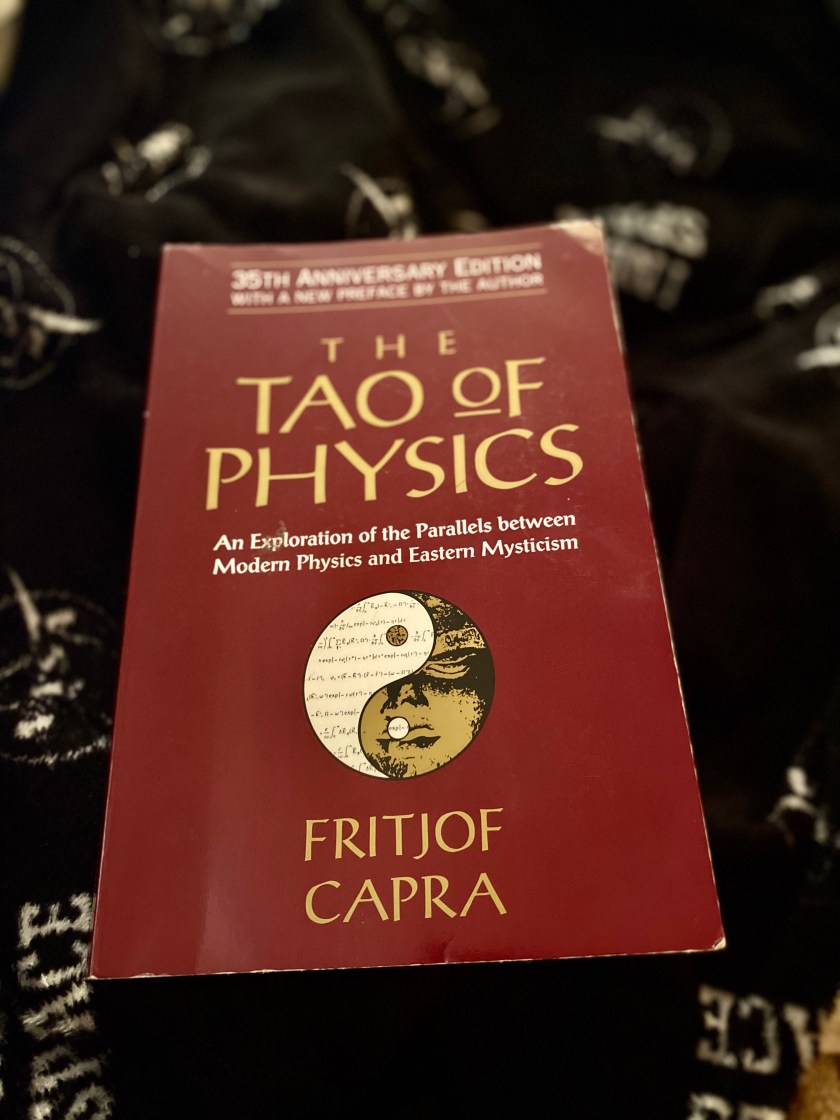
What’s great is that a lot of mystical ideas within Taoism, ideals which could have been scientific had the philosophers not seen analysis as such a waste of time (in a lot of ways it is, though), have been and continue to be paralleled with modern science, particularly physics. The Tao of Physics by physicist Fritjof Capra is a great book to read more on this subject. I read it a few months ago, and it’s the book pictured at the top of this blog.

The Daoist way acknowledges and observes the natural transformation of things in nature, like the blossoming and decaying of a flower. Yes, this is where the T’ai-Chi T’u diagram comes in: it represents the unification of these polar opposites: one must exist for the other to exist. We’re talking, of course, about Yin and Yang. A consequence of life is death (or cellular regeneration if we’re talking freaky single cell organisms) and you cannot have died without once having been alive. In fact, we would have no concept of being alive or living if death did not rear its gentle head. And if we were always dead, well, we wouldn’t know it and words for it wouldn’t exist.

Both Yin (the darker element of existence representative of the earth) and Yang (the creative, heavenly—meaning not of earth—element of existence) have equal importance and balance everything. The symbol’s flowing movement, according to Capra, represents continuous cycles; in other words, these opposites are constantly within each other, influencing each other, and being each other because if they were alone, neither would exist.

This isn’t a Western way of thought. Here, someone is either guilty or innocent. Something is either right, or wrong. The flower is either alive or dead, and we see these things as separate from each other in the same way we see ourselves separate from each other. You can see this disconnect rooted in things like in segregation, in P.C culture, and in Mental Health. And because we don’t ascribe to the idea of fluid existence, of fluid transformation, because everything for us is so hard lined and linear—which is only logical because we experience existence in a physical sense despite knowing Time isn’t linear—we’ve developed an individualist and autonomous society.

That’s not to say it’s wrong. In fact, I stopped believing in the hard sense of right and wrong a long time ago.

And so how can something so abstract apply to life and how in the world did it help me balance madness?

Chuang Tzu explains this beautifully:

“The sayings ‘shall we not follow and honour the right and have nothing to do with the wrong?‘ and ‘shall we not follow and honour those who secure good government and have nothing to do with those who produce disorder?’ Show a want if acquaintance with the principals of Heaven [not of earth; cosmos, spiritual universe] and Earth and with the different qualities of things. It is like following and honouring Heaven and taking no account of Earth; it is like following and honouring the yin and taking no account of the yang.”

Chuang Tzu. Also quoted in The Tao of Physics.

And suddenly life made a lot of sense.

Suddenly I understood why conclusions of morality always felt so contrived. I understood why “staying positive” never worked, and never would. I understood separation and dissociation and, most of all, I understood the fluid duality of everything, including my demons.

They weren’t demons after all, just as I’d suspected. I call them false angels now, because they are good in their badness and bad in their goodness. They couldn’t be demons because according to this natural, fluid transformation and existence of all things in the universe, everything has a polar opposite. Yes, classical physics tells us this, but not in terms of fluidity.

A demon has no goodness. But because I looked through this lens of consistently being unified with all opposites, these voices and spirits had no choice but to be both good and bad. They struggled with the universal order just like every particle, every force, every human.

This concept I have brought into the novel I’ve been working on, and I’m not mentioning how much I processed these thoughts through a first draft years ago, so whenever it gets published and you read it (and you WILL read it) you will see the similarities and thought process. You will think back to this post and say hey, I remember this! I was there! I. Was. There.

I could empathize with being torn apart by duality. I often found myself between sanity and madness. Between the right decision or the wrong decision. Between living and dying. Between happy and sad. And so I empathized with these damaged, clever, and now exposed beings. I saw the path they carved, the fork in the road that they drove me toward, and saw that this was never a battle between light and dark like I interpreted. They were always both protecting and hurting me; it’s the natural order of things.

That’s the real reason I stopped fighting. Not because I couldn’t anymore, not because I was too tired or because a bunch of therapists told me to, but because I recognized the pain and confusion and duality that radiates through the waves of the entire universe. I saw myself in it, and slowly my fear dissolved.

I get frustrated sometimes still at things they say or things I feel they’re influencing. I get swept away sometimes still, too. I mentioned before I thought of voluntarily committing myself some weeks ago. So this has not eliminated the struggle. What it’s done is give it purpose. It’s given it a place in the universe. It’s given me a reason not to feel sorry for myself or tortured or scream “why me!” Into the sky. It’s helped me learn to share my body and mind and the power of thought with whatever it is in my head, whether that’s a few misguided chemicals or actual spiritual contact. Neither are different from each other: they both follow that natural, fluid rotation. They are bound by the chaotic, ordered, unity of opposites.

This is the reason not referring to myself as “mentally ill” or “sick” has always set me free. This is why listening to my body and choosing to stray from medication was the right decision for me.

Philosophy saves lives.

Would you like to continue the conversation, see silly (and beautiful) photos, or nonsensical two second videos? Great! Follow me:

Instagram: @written_in_the_photo

*New* Twitter: @philopsychotic

Snapchat: @FabulousIRLTho

If you liked this article, please share it, hit the star, and follow ThePhilosophicalPsychotic on WordPress or with email notifications. I appreciate every reader and commentator. You give me more reason to continue this joyous hobby.

Posted in Freedom, Peer Support

This Is How We End Stigma

If there’s anything I’m leaving behind in 2019, it’s the teenaged, damaged version of me. I’m leaving behind immaturity and replacing it with realistic observation and contemplation. I’m respecting the graves of my trauma, enough that I can finally leave the cemetery. I’m not looking for anything in 2020. I will understand myself better and I will reach the potential I’ve always had. I will be turning 25 in 2020.

I started my old blog Mental Truths in July 2015. My last post was sometime early 2019. As I read through old posts, I realized how lost and confused and disconnected I was. It was mental health rants sprinkled with a hint of actual coherent thought.

And what I’ve learned between July 2015 and December 2019 is that the complexities of life are not only beautiful, they are terrifying. I learned there is nothing inherently wrong with terror and fear. I learned we often allow ourselves to be controlled by these primal reactions to life. I learned how our body and mind respond to life is dependent on more factors than neurotransmitters or trauma.

I went from an anti-psychiatry extremist to someone who sees more division within the mental health community than in those outside of the community who move against us or refuse to accept us. I learned Stigma is real and also bullshit.

We self-stigmatize more than others stigmatize us. We hold our struggles against others, as if the entire world doesn’t suffer in some way at some point. As if our personal struggle is so great that family, friends, partners, should put our health before their own, and if they don’t, they’re being “unreasonable” or they “don’t care”. As if everything revolves around us.

As if we must force people to accept us. We don’t.

People won’t accept us until we accept ourselves. Until we stop pretending the experience of voices and visions hold more pain and torment and severity than the experience of anxiety and panic. Until we recognize we all hurt.

This holds true for any inequality. I am mixed race, my father is African American, my mother is Caucasian, with her family having immigrated from Poland. Much of my life has been dictated by a cultural identity crisis. I didn’t fit in with the white kids, I didn’t fit in with the black kids, and I felt like I had to fit in with one of them. I was the only non-Hispanic in a college prep class that was supposed to be specified toward low-income, first generation college bound students. Instead, it was geared toward brown students who had a pretty good home life and high income. It took four years for them to integrate other races. And by other races, I mean two white kids.

And so I was very angry. I was sick of watching movies and documentaries in my college prep class ONLY dedicated toward brown students. I was sick of teachers handing me Spanish instructions for my parents and looking at me weird when I said I didn’t speak Spanish.

I felt erased. I felt degraded. Invisible. Ignored. And this is the result of a culture believing pain has hierarchy. A culture that thinks every little mention of skin color or inequality is fulfilling a racist culture. A culture where “you don’t look/act schizophrenic” is actually a sentence that’s uttered.

I had a right to be angry. But looking back, I placed myself on a pedestal. That “I’m more disadvantaged than you” type of superiority that seems to plague every ethnicity and every culture in some way.

Fear is a strong emotion. And psychological research has shown in countless studies that we often misinterpret our own feelings and signals we receive from our body. What may be fear may register as anger or sadness or even arousal. Looking back, I know now that I feared everything not because I didn’t fit in, but because I didn’t know myself. Sometimes arrogance and superiority becomes a barrier against the world.

And that’s happening in the mental health community. We fear our experiences often, we fear the thought of never “getting better”, we fear rejection and misunderstanding. And so we strive to prove we are sick. We strive to prove we are in pain, that we suffer, and in the middle of that battle we engage in friendly fire.

I’ve spent the last three years working on my fear. I was tired of being a prisoner and being sick meant I was a prisoner. Being “okay against my will” as one singer puts it, meant I was a prisoner. And so I dove into fear and terrified myself. I stopped being okay and in not being okay I became even better than okay.

What the mental health community needs right now isn’t stupid stigma campaigns.

What changes would we see in our wonderfully versatile, talented, and strong community if we were to stop seeing ourselves as the broken branches on the tree of society? What changes would we see if we stopped calling ourselves sick and instead called ourselves varied? Experienced? Raw? If we see ourselves as fully human, fully capable, intelligent, fierce, and in a lot of pain, the world will follow.

The world can understand pain. Let’s not make it any more complicated than that.

Would you like to continue the mental health conversation, see silly (and beautiful) photographs, or nonsensical two second videos? Great! Follow me:

Instagram: @written_in_the_photo

*New* Twitter: @philopsychotic

Snapchat: @FabulousIRLTho

If you liked this article, please share it, hit the star, and follow ThePhilosophicalPsychotic on WordPress or with email notifications. I appreciate every reader and commentator. You give me more reason to continue this joyous hobby.

Posted in Freedom, Voices

The Advantages of Pain

Let’s have a discussion about the power hidden within struggle.

After the loss of control that a crisis brings, it feels impossible sometimes to regain a sense of self and place in the world. You doubt yourself, you doubt your beliefs, your happiness, or any chance that this darker side of life has anything other than despair and mental anguish to offer.

I see a lot of #mentalhealthawareness tweets and posts on instagram that talk about how hard it is to have anxiety or how depression stops people from living life or how their mental torment holds them back in some way, and because of that the general public should stop using mental health terminology as adjectives, or the general public should “educate themselves” on what it means to have this devastating “mental illness”.

Then, there are other posts which are meant to encourage people stuck in these dark times to remember that they are strong for dealing with the pain that they deal with, and no one can tell them otherwise.

I’m never one to silence a voice, or voices in this case, but I do think we miss the mark a lot. It’s not really about how hard everything is, it’s about what we’re taught from that hardship. If you feel you haven’t learned anything, I encourage you to dig until you hit water.

It’s also not really about you being strong. Everyone struggles. Every single person in the world. And this isn’t to compare pains to one another. This is to say that if there’s one thing the human race shares across borders, it’s pain. We’re built, physically and mentally, to endure a lot of shit. The struggle worsens, though, when you lose faith and trust in your body and/or your mind. When you believe you’re inept to face a challenge, you’re basically telling your body “I don’t trust you to handle this”, and your mind “I don’t trust you to make it through this”.

The problem with that, in my completely hypothetical and unscientific proposition here, is that your body and mind start mistrusting you too. And when you’re out of sync with the two major systems keeping you conscious and alive, than you’re existing in a void.

I think the greatest lesson I have learned in experiencing psychosis is how important my body and mind are to me. I felt such a strong disconnect from my entire self. Nothing made sense. My body had aches and pains I didn’t understand and my mind told me things that didn’t make sense, things that came to me like an idea for a short story and ended up as a first, incoherent draft of a horror manuscript.

Making a decision to come off medication became a catalyst for reuniting myself with my body—the first step in my real recovery. But it wasn’t the physical act of getting off the medication that saved me. It was the fact that I made a decision based on what my body told me. I sat for some weeks and listened to my internal system until the cries were finally recognized. Hearing those cries and abiding by them restored a lot of trust between my body and myself.

My mind came next. I plunged into utter darkness. Voices said I should kill myself, and I tried. I was tackled into safety. No, I was not hospitalized that time.

But for the first time in this darkness, I let it sweep me away. I didn’t shoot arrows or fill my moat. I let evil overrun my castle and I shook its hand. It pulled me down a spiral of agony and I saw the deepest, rotted pits of my mind. I didn’t cry because I was fearful of that. I cried because darkness lead me around these pits and showed me the decaying feelings I’d neglected. The traumas I’d abused. I cried because I’d been hurting myself and I never knew it.

It’s been over a year since my descent, since I stopped taking the medication, since I got back into the gym and nurturing my body. I’ve made space in my physical self and mental self for aches and pains and darkness. I have a voice who reminds me when I’m not okay, or asks me if I’m okay when I feel a little rocky. In fact, with all of the thoughts and voices in my head, I’ve reached a compromise: we either live in this body together or none of us live at all.

I want to live. They want to live. And so we leave space for each other.

“Recovery”, or whatever you’d like to call it, for me isn’t about being strong or resilient or tweeting about how much my life has changed or instagramming paragraphs about why hope should never die. It’s about a willingness to be terrified. It’s about reconnecting myself with what I’d been too fearful to face. Granted, I didn’t do this all on my own. I had friends and therapists and some bad group therapy experiences, all of which lead me back to looking inside of myself.

This is why you will never catch me on social media telling people what they want to hear. What they want to hear is the same script that’s everywhere: you can live a normal life. Take control. Be your best you. It’s possible to live with “mental illness”.

That’s all fine if you just want to exist. But it’s deeper than that for me. Giving up control gave me more freedom than fighting for control. I don’t “live with mental illness” because I’ve been labeled schizoaffective. I just “live with myself” like every other damn human being.

We think we’re so different from others. For some of us, that makes us feel entitled, like we deserve special treatment because “we’re sick”. And then we turn around and demand we also be treated the same as everyone else. Classic identity crisis if you ask me.

For me, that mindset just never quite cut the cake.

So, there is deep beauty in suffering, and deep agony in happiness. Our minds and our bodies are built for adaptation. They’re built to endure. Trust in this.

Would you like to continue the mental health conversation, see silly (and beautiful) photographs, and nonsensical two second videos? Great! Follow me:

Instagram: @written_in_the_photo

*New* Twitter: @philopsychotic

Snapchat: @FabulousIRLTho

If you liked this article, share it, hit the star, sign up for email notifications, or hit the FOLLOW button. I appreciate every reader and commentator. You give me more reason to continue this joyous hobby.